
 |
| Valentine's Day, |
Valentine's Day, also called Saint Valentine's Day or the Feast of Saint Valentine,
is celebrated annually on February 14. Originating as a Western Christian feast day honoring one or two early saints named Valentinus, Valentine's Day is recognized as a significant cultural, religious, and commercial celebration of romance and romantic love in many regions around the world.
There are numerous martyrdom stories associated with various Valentines connected to February 14,including a written account of Saint Valentine of Rome's imprisonment for performing weddings for soldiers who were forbidden to marry and for ministering to Christians persecuted under the Roman Empire.
According to legend, Saint Valentine restored sight to the blind daughter of his judge, and he wrote her a letter signed "Your Valentine" as a farewell before his execution.
The Feast of Saint Valentine was established by Pope Gelasius I in AD 496 to be celebrated on February 14 in honour of the Christian martyr, Saint Valentine of Rome, who died on that date in AD 269.
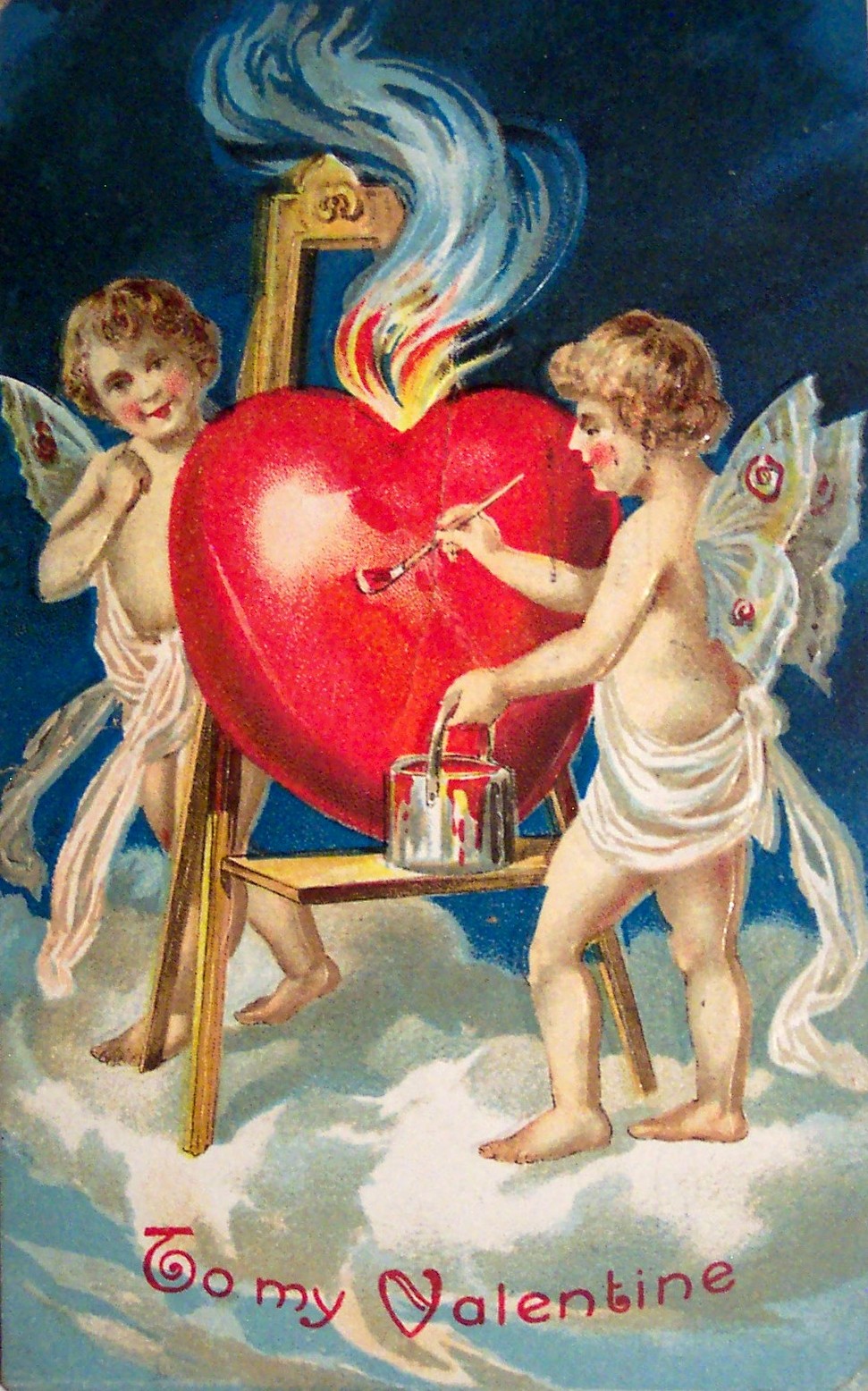
The day first became associated with romantic love within the circle of Geoffrey Chaucer in the 14th century, when the tradition of courtly love flourished. In 18th-century England, it grew into an occasion in which couples expressed their love for each other by presenting flowers, offering confectionery, and sending greeting cards (known as "valentines"). Valentine's Day symbols that are used today include the heart-shaped outline, doves, and the figure of the winged Cupid. Since the 19th century, handwritten valentines have given way to mass-produced greeting cards.
In Europe, Saint Valentine's Keys are given to lovers "as a romantic symbol and an invitation to unlock the giver's heart", as well as to children to ward off epilepsy (called Saint Valentine's Malady).
Although not a public holiday in any country, Saint Valentine's Day is an official feast day in the Anglican Communion and the Lutheran Church.Many parts of the Eastern Orthodox Church also celebrate Saint Valentine's Day on July 6 and July 30, the former date in honor of Roman presbyter Saint Valentine, and the latter date in honor of Hieromartyr Valentine, the Bishop of Interamna (modern Terni).

History
Numerous early Christian martyrs were named Valentine.The Valentines honored on February 14 are Valentine of Rome (Valentinus presb. m. Romae) and Valentine of Terni (Valentinus ep. Interamnensis m. Romae).Valentine of Rome was a priest in Rome who was martyred in 269 and was added to the calendar of saints by Pope Gelasius I in 496 and was buried on the Via Flaminia. The relics of Saint Valentine were kept in the Church and Catacombs of San Valentino in Rome, which "remained an important pilgrim site throughout the Middle Ages until the relics of St. Valentine were transferred to the church of Santa Prassede during the pontificate of Nicholas IV".The flower-crowned skull of Saint Valentine is exhibited in the Basilica of Santa Maria in Cosmedin, Rome. Other relics are found at Whitefriar Street Carmelite Church in Dublin, Ireland.
Valentine of Terni became bishop of Interamna and is said to have been martyred during the persecution under Emperor Aurelian in 273. He is buried on the Via Flaminia, but in a different location from Valentine of Rome. His relics are at the Basilica of Saint Valentine in Terni (Basilica di San Valentino). Jack B. Oruch states that "abstracts of the acts of the two saints were in nearly every church and monastery of Europe."
The Catholic Encyclopedia also speaks of a third saint named Valentine who was mentioned in early martyrologies under date of February 14. He was martyred in Africa with a number of companions, but nothing more is known about him. Saint Valentine's head was preserved in the abbey of New Minster, Winchester, and venerated.
February 14 is celebrated as St. Valentine's Day in various Christian denominations; it has, for example, the rank of 'commemoration' in the calendar of saints in the Anglican Communion. In addition, the feast day of Saint Valentine is also given in the calendar of saints of the Lutheran Church. However, in the 1969 revision of the Catholic Calendar of Saints, the feast day of Saint Valentine on February 14 was removed from the General Roman Calendar and relegated to particular (local or even national) calendars for the following reason: "Though the memorial of Saint Valentine is ancient, it is left to particular calendars, since, apart from his name, nothing is known of Saint Valentine except that he was buried on the Via Flaminia on February 14.
The feast day is still celebrated in Balzan (Malta) where relics of the saint are claimed to be found, and also throughout the world by Traditionalist Catholics who follow the older, pre-Second Vatican Council calendar.
In the Eastern Orthodox Church, St. Valentine is recognized on July 6, in which Saint Valentine, the Roman presbyter, is honored; in addition, the Eastern Orthodox Church observes the feast of Hieromartyr Valentine, Bishop of Interamna, on July 30
In 1797, a British publisher issued The Young Man's Valentine Writer, which contained scores of suggested sentimental verses for the young lover unable to compose his own. Printers had already begun producing a limited number of cards with verses and sketches, called "mechanical valentines." Paper Valentines became so popular in England in the early 19th century that they were assembled in factories. Fancy Valentines were made with real lace and ribbons, with paper lace introduced in the mid-19th century. In 1835, 60,000 Valentine cards were sent by post in the United Kingdom, despite postage being expensive.
A reduction in postal rates following Sir Rowland Hill's postal reforms with the 1840 invention of the postage stamp (Penny Black) saw the number of Valentines posted an increase, with 400,000 sent just one year after its invention, and ushered in the less personal but easier practice of mailing Valentines. That made it possible for the first time to exchange cards anonymously, which is taken as the reason for the sudden appearance of racy verse in an era otherwise prudishly Victorian. Production increased, "Cupid's Manufactory" as Charles Dickens termed it, with over 3,000 women employed in manufacturing. The Laura Seddon Greeting Card Collection at Manchester Metropolitan University gathers 450 Valentine's Day cards dating from early nineteenth-century Britain, printed by the major publishers of the day. The collection appears in Seddon's book Victorian Valentines (1996).
Flowers, such as red roses (pictured), are often sent on Valentine's Day
In the United States, the first mass-produced Valentines of embossed paper lace were produced and sold shortly after 1847 by Esther Howland (1828–1904) of Worcester, Massachusetts. Her father operated a large book and stationery store, but Howland took her inspiration from an English Valentine she had received from a business associate of her father. Intrigued by the idea of making similar Valentines, Howland began her business by importing paper lace and floral decorations from England. A writer in Graham's American Monthly observed in 1849, "Saint Valentine's Day ... is becoming, nay it has become, a national holiday." The English practice of sending Valentine's cards was established enough to feature as a plot device in Elizabeth Gaskell's Mr. Harrison's Confessions (1851): "I burst in with my explanations: 'The valentine I know nothing about.' 'It is in your handwriting', said he coldly." Since 2001, the Greeting Card Association has been giving an annual "Esther Howland Award for a Greeting Card Visionary".

Since the 19th century, handwritten notes have given way to mass-produced greeting cards. In the UK, just under half of the population spend money on their Valentines, and around £1.9 billion was spent in 2015 on cards, flowers, chocolates and other gifts. The mid-19th century Valentine's Day trade was a harbinger of further commercialized holidays in the U.S. to follow.

A gift box of chocolates, which is a common gift for Valentine's Day
In 1868, the British chocolate company Cadbury created Fancy Boxes – a decorated box of chocolates – in the shape of a heart for Valentine's Day. Boxes of filled chocolates quickly became associated with the holiday. In the second half of the 20th century, the practice of exchanging cards was extended to all manner of gifts, such as giving jewelry.
The U.S. Greeting Card Association estimates that approximately 190 million valentines are sent each year in the US. Half of those valentines are given to family members other than husband or wife, usually to children. When the valentine-exchange cards made in school activities are included the figure goes up to 1 billion, and teachers become the people receiving the most valentines. The average valentine's spending has increased every year in the U.S, from $108 a person in 2010 to $131 in 2013.
The rise of Internet popularity at the turn of the millennium is creating new traditions. Millions of people use, every year, digital means of creating and sending Valentine's Day greeting messages such as e-cards, love coupons or printable greeting cards. An estimated 15 million e-valentines were sent in 2010. Valentine's Day is considered by some to be a Hallmark holiday due to its commercialization.
In the modern era, liturgically, the Anglican Church has a service for St. Valentine's Day (the Feast of St. Valentine), which includes the optional rite of the renewal of marriage vows. In 2016, Catholic Bishops of England and Wales established a novena prayer "to support single people seeking a spouse ahead of St Valentine's Day."

Celebration and status worldwide
Valentine's Day customs – sending greeting cards (known as “valentines”), offering confectionary and presenting flowers – developed in early modern England and spread throughout the English-speaking world in the 19th century. In the later 20th and early 21st centuries, these customs spread to other countries, but their effect has been more limited than those of Hallowe'en, or than aspects of Christmas, (such as Santa Claus).[citation needed]
Valentine's Day is celebrated in many East Asian countries with Singaporeans, Chinese and South Koreans spending the most money on Valentine's gifts.
Americas
Latin America
In most Latin American countries, for example, Costa Rica, Mexico, and Puerto Rico, Saint Valentine's Day is known as Día de Los Enamorados (day of lovers) or as Día del Amor y la Amistad (Day of Love and Friendship). It is also common to see people perform "acts of appreciation" for their friends. In Guatemala, it is known as the "Día del Cariño" (Affection Day). Some countries, in particular, the Dominican Republic and El Salvador, have a tradition called Amigo Secreto ("Secret friend"), which is a game similar to the Christmas tradition of Secret Santa.
In Brazil, the Dia dos Namorados (lit. "Lovers' Day", or "Boyfriends'/Girlfriends' Day") is celebrated on June 12, probably because that is the day before Saint Anthony's day, known there as the marriage saint, when traditionally many single women perform popular rituals, called sympathies, in order to find a good husband or boyfriend. Couples exchange gifts, chocolates, cards, and flower bouquets. The February 14 Valentine's Day is not celebrated at all because it usually falls too little before or too little after the Brazilian Carnival – that can fall anywhere from early February to early March and lasts almost a week. Because of the absence of Valentine's Day and due to the celebrations of the Carnivals, Brazil was recommended by U.S. News & World Report as a tourist destination during February for Western singles who want to get away from the holiday.
Colombia celebrates Día del Amor y la Amistad on the third Saturday in September instead. Amigo Secreto is also popular there.
United States
Conversation hearts, candies with messages on them that are strongly associated with Valentine's Day.
In the United States, about 190 million Valentine's Day cards are sent each year, not including the hundreds of millions of cards school children exchange.
Valentine's Day is a major source of economic activity, with total expenditures in 2017 topping $18.2 billion in 2017 or over $136 per person. This is an increase from $108 per person in 2010.
Asia
Afghanistan
In the Afghan tradition, love is often expressed through poetry. Some new generation budding poets like Ramin Mazhar, Mahtab Sahel are expressing themselves through poetry using Valentine’s Day expressing concerns on any likelihood of erosion of freedoms. In their political comment, they defy fear by saying 'I kiss you amid the Taliban'
China
See also: The Cowherd and the Weaver Girl
In Chinese, Valentine's Day is called lovers' festival (simplified Chinese: 情人节; traditional Chinese: 情人節; Mandarin: Qīng Rén Jié; Hokkien: Chêng Lîn Chiat; Cantonese: Chìhng Yàhn Jit; Shanghainese Xin Yin Jig). The "Chinese Valentine's Day" is the Qixi Festival, celebrated on the seventh day of the seventh month of the lunar calendar. It commemorates a day on which a legendary cowherd and weaving maid are allowed to be together. In Chinese culture, there is an older observance related to lovers, called "The Night of Sevens" (Chinese: 七夕; pinyin: Qi Xi). According to the legend, the Cowherd star and the Weaver Maid star are normally separated by the Milky Way (silvery river) but are allowed to meet by crossing it on the 7th day of the 7th month of the Chinese calendar.
In recent years, celebrating White Day has also become fashionable among some young people.
India
Main article: Valentine's Day in India
In India, in antiquity, there was a tradition of adoring Kamadeva, the lord of love; exemplified by the erotic carvings in the Khajuraho Group of Monuments and by the writing of the Kamasutra. This tradition was lost around the Middle Ages when Kamadeva was no longer celebrated, and public displays of sexual affection became frowned upon. This repression of public affections began to loosen in the 1990s.
Valentine's Day celebrations did not catch on in India until around 1992. It was spread due to the programs in commercial TV channels, such as MTV, dedicated radio programs, and love letter competitions, in addition to an economical liberalization that allowed the explosion of the valentine card industry. The celebration has caused a sharp change in how people have been displaying their affection in public since the Middle Ages.
In modern times, Hindu and Islamic traditionalists have considered the holiday to be cultural contamination from the West, a result of globalization in India. Shiv Sena and the Sangh Parivar have asked their followers to shun the holiday and the "public admission of love" because of them being "alien to Indian culture". Although these protests are organized by political elites, the protesters themselves are middle-class Hindu men who fear that the globalization will destroy the traditions in their society: arranged marriages, Hindu joint families, full-time mothers, etc.
Despite these obstacles, Valentine's Day is becoming increasingly popular in India.
Valentine's Day has been strongly criticized from a postcolonial perspective by intellectuals from the Indian left. The holiday is regarded as a front for "Western imperialism", "neocolonialism", and "the exploitation of working classes through commercialism by multinational corporations". It is claimed that as a result of Valentine's Day, the working classes and rural poor become more disconnected socially, politically, and geographically from the hegemonic capitalist power structure. They also criticize mainstream media attacks on Indians opposed to Valentine's Day as a form of demonization that is designed and derived to further the Valentine's Day agenda. Right-wing Hindu nationalists are also hostile. In February 2012, Subash Chouhan of the Bajrang Dal warned couples that "They cannot kiss or hug in public places. Our activists will beat them up". He said, "We are not against love, but we criticize vulgar exhibition of love at public places".
Iran
In the first part of the 21st century, the celebration of Valentine's Day in Iran has been harshly criticized by Islamic teachers who see the celebrations as opposed to Islamic culture. In 2011, the Iranian printing works owners' union issued a directive banning the printing and distribution of any goods promoting the holiday, including cards, gifts, and teddy bears. "Printing and producing any goods related to this day including posters, boxes, and cards emblazoned with hearts or half-hearts, red roses and any activities promoting this day are banned ... Outlets that violate this will be legally dealt with", the union warned.
In Iran, the Sepandarmazgan, or Esfandegan, is a festival where people express love towards their mothers and wives, and it is also a celebration of earth in ancient Persian culture. It has been progressively forgotten in favor of the Western celebration of Valentine's Day. The Association of Iran's Cultural and Natural Phenomena has been trying since 2006 to make Sepandarmazgan a national holiday on February 17, in order to replace the Western holiday.
Israel
In Israel, the Jewish tradition of Tu B'Av has been revived and transformed into the Jewish equivalent of Valentine's Day. It is celebrated on the 15th day of the month of Av (usually in late August). In ancient times girls would wear white dresses and dance in the vineyards, where the boys would be waiting for them (Mishna Taanith end of Chapter 4). Today, Tu B'Av is celebrated as a second holiday of love by secular people (along with Valentine's Day), and it shares many of the customs associated with Saint Valentine's Day in western societies. In modern Israeli culture, Tu B'Av is a popular day to proclaim love, propose marriage, and give gifts like cards or flowers.
Japan
In Japan, Morozoff Ltd. introduced the holiday for the first time in 1936, when it ran an advertisement aimed at foreigners. Later, in 1953, it began promoting the giving of heart-shaped chocolates; other Japanese confectionery companies followed suit thereafter. In 1958, the Isetan department store ran a "Valentine sale". Further campaigns during the 1960s popularized the custom.
The custom that only women give chocolates to men may have originated from the translation error of a chocolate-company executive during the initial campaigns. In particular, office ladies give chocolate to their co-workers. Unlike western countries, gifts such as greeting cards, candies, flowers, or dinner dates are uncommon, and most of the gifts-related activity is about giving the right amount of chocolate to each person. Japanese chocolate companies make half their annual sales during this time of the year.
Many women feel obliged to give chocolates to all male co-workers, except when the day falls on a Sunday, a holiday. This is known as Giri-Choko (義理チョコ), from Giri ("obligation") and Choko, ("chocolate"), with unpopular co-workers receiving only "ultra-obligatory" chō-Giri Choko cheap chocolate. This contrasts with honmei-choko (本命チョコ, lit. "true feeling chocolate"), chocolate given to a loved one. Friends, especially girls, may exchange chocolate referred to as tomo-choko (友チョコ); from tomo meaning "friend".
In the 1980s, the Japanese National Confectionery Industry Association launched a successful campaign to make March 14 a "reply day", where men are expected to return the favour to those who gave them chocolates on Valentine's Day, calling it White Day for the color of the chocolates being offered. A previous failed attempt to popularize this celebration had been done by a marshmallow manufacturer who wanted men to return marshmallows to women.
In Japan, the romantic "date night" associated with Valentine's Day is celebrated on Christmas Eve.
Lebanon
Valentine's Day-themed bouquet of cupcakes
Saint Valentine is the patron saint for a large part of the Lebanese population. Couples take the opportunity of Valentine's feast day to exchange sweet words and gifts as proof of love. Such gifts typically include boxes of chocolates, cupcakes, and red roses, which are considered the emblem of sacrifice and passion.
Lebanese people celebrate Valentine's Day in a different way in every city. In Beirut, men take women out to dine and may buy them a gift. Many women are asked to marry on that day. In Sidon, Valentine's Day is celebrated with the whole family – it is more about family love than a couple's love.
Malaysia
Islamic officials in West Malaysia warned Muslims against celebrating Valentine's Day, linking it with vice activities. Deputy Prime Minister Muhyiddin Yassin said the celebration of romantic love was "not suitable" for Muslims. Wan Mohamad Sheikh Abdul Aziz, head of the Malaysian Islamic Development Department (Jakim), which oversees the country's Islamic policies said that a fatwa (ruling) issued by the country's top clerics in 2005 noted that the day 'is associated with elements of Christianity,' and 'we just cannot get involved with other religions' worshipping rituals.' Jakim officials planned to carry out a nationwide campaign called "Awas Jaret Valentine's Day" ("Mind Valentine's Day Trap"), aimed at preventing Muslims from celebrating the day on February 14, 2011. Activities include conducting raids in hotels to stop young couples from having unlawful sex and distributing leaflets to Muslim university students warning them against the day.
On Valentine's Day 2011, West Malaysian religious authorities arrested more than 100 Muslim couples concerning the celebration ban. Some of them would be charged in the Shariah Court for defying the department's ban against the celebration of Valentine's Day.
In East Malaysia, the celebration is much more tolerated among young Muslim couples although some Islamic officials and Muslim activists from the Westside have told younger generations to refrain from such celebration by organizing da'wah and tried to spread their ban into the East. In both the states of Sabah and Sarawak, the celebration is usually common with flowers.
Pakistan
Main article: Valentine's Day in Pakistan
The concept of Valentine's Day was introduced into Pakistan during the late 1990s with special TV and radio programs. The Jamaat-e-Islami political party has called for the banning of Valentine's Day celebration. Despite this, the celebration is becoming popular among urban youth and the florists expect to sell a great number of flowers, especially red roses. The case is the same with card publishers.
In 2016, the local governing body of Peshwar officially banned the celebration of Valentine's Day in the city. The ban was also implemented in other cities such as Kohat by the local governments.
In 2017, the Islamabad High Court banned Valentine's Day celebrations in public places in Pakistan
Philippines
In the Philippines, Valentine's Day is called Araw ng mga Puso in much the same manner as in the West. It is usually marked by a steep increase in the price of flowers, particularly red roses. It is the most popular day for weddings, with some localities offering mass ceremonies for no charge.
Saudi Arabia
In Saudi Arabia, in 2002 and 2008, religious police banned the sale of all Valentine's Day items, telling shop workers to remove any red items, because the day is considered a Christian holiday. This ban has created a black market for roses and wrapping paper. In 2012, the religious police arrested more than 140 Muslims for celebrating the holiday and confiscated all red roses from flower shops. Muslims are not allowed to celebrate the holiday, and non-Muslims can celebrate only behind closed doors.
"Saudi cleric Sheikh Muhammad Al-'Arifi said on Valentine's Day Eve that celebrating this holiday constitutes bid'a – a forbidden innovation and deviation from religious law and custom – and mimicry of the West."
However, in 2017 and 2018, after a fatwa was widely circulated, the religious police did not prevent Muslims from celebrating the day.
Singapore
According to findings, Singaporeans are among the biggest spenders on Valentine's Day, with 60% of Singaporeans indicating that they would spend between $100 and $500 during the season leading up to the holiday.
South Korea
In South Korea, women give chocolate to men on February 14, and men give non-chocolate candy to women on March 14 (White Day). On April 14 (Black Day), those who did not receive anything on February or March 14 go to a Chinese-Korean restaurant to eat black noodles (자장면 jajangmyeon) and lament their 'single life'. Koreans also celebrate Pepero Day on November 11, when young couples give each other Pepero cookies. The date '11/11' is intended to resemble the long shape of the cookie. The 14th of every month marks a love-related day in Korea, although most of them are obscure. From January to December: Candle Day, Valentine's Day, White Day, Black Day, Rose Day, Kiss Day, Silver Day, Green Day, Music Day, Wine Day, Movie Day, and Hug Day. Korean women give a much higher amount of chocolate than Japanese women.
Taiwan
Taipei 101 in Valentine's Day 2006
In Taiwan, traditional Qixi Festival, Valentine's Day and White Day are all celebrated. However, the situation is the reverse of Japan's. Men give gifts to women on Valentine's Day, and women return them on White Day.
Europe
United Kingdom
In the UK, just under half of the population spend money on their Valentines and around £1.3 billion is spent yearly on cards, flowers, chocolates, and other gifts, with an estimated 25 million cards being sent.
In Wales, some people celebrate Dydd Santes Dwynwen (St. Dwynwen's Day) on January 25 instead of (or as well as) Valentine's Day. The day commemorates St Dwynwen, the Welsh patron saint of love.
The Welsh name for Saint Valentine is Sant Ffolant.
Ireland
Many Christians make a pilgrimage to Whitefriar Street Carmelite Church on Saint Valentine's Day to implore the intercession of Saint Valentine in their prayers, with the hope of finding true love
On Saint Valentine's Day in Ireland, many individuals who seek true love make a Christian pilgrimage to the Shrine of St. Valentine in Whitefriar Street Carmelite Church in Dublin, which is said to house relics of Saint Valentine of Rome; they pray at the shrine in hope of finding romance. There lies a book in which foreigners and locals have written their prayer requests for love.
Finland and Estonia
In Finland, Valentine's Day is called ystävänpäivä which translates into "Friend's Day". As the name indicates, this day is more about remembering friends, not significant others. In Estonia, Valentine's Day is called sõbrapäev, which has the same meaning.
France
In France, a traditionally Catholic country, Valentine's Day is known simply as "Saint Valentin", and is celebrated in much the same way as other western countries. The relics of Saint Valentin de Terni, the patron of the St Valentine's Day, are in the Catholic church of Saint-Jean-Baptiste and Saint-Jean-l’Evangéliste located in the southern France town of Roquemaure, Gard. The celebrations of "Fête des Amoureux" takes place every two years on the Sunday closest to February 14. The village gets dressed in its 19th-century costume and put on the program with over 800 people.
Greece
St. Valentine's Day, or Ημέρα του Αγίου Βαλεντίνου in Greek tradition was not associated with romantic love. In the Eastern Orthodox church there is another Saint who protects people who are in love, Hyacinth of Caesarea (feast day July 3), but this was not widely known until the late 1990s In contemporary Greece, Valentine's Day is generally celebrated as in the common Western tradition.
Portugal
In Portugal, the holiday is known as "Dia dos Namorados" (Lover's Day / Day of the Enamoured). As elsewhere, couples exchange gifts, but in some regions, women give a lenço de namorados ("lovers' handkerchief"), which is usually embroidered with love motifs.
Romania
In recent years, Romania has also started celebrating Valentine's Day. This has drawn backlash from several groups, institutions, and nationalist organizations like Noua Dreaptǎ, who condemn Valentine's Day for being superficial, commercialist, and imported Western kitsch. In order to counter the perceived denaturation of national culture, Dragobete, a spring festival celebrated in parts of Southern Romania, has been rekindled after having been ignored during the Communist years as the traditional Romanian holiday for lovers. The holiday is named after a character from Romanian folklore who was supposed to be the son of Baba Dochia. Its date used to vary depending on the geographical area, however nowadays it is commonly observed on February 24.
Scandinavia
In Denmark and Norway, February 14 is known as Valentinsdag, and it is celebrated in much the same manner as in the United Kingdom. In Sweden it is called Alla hjärtans dag ("All Hearts' Day") and is not widely celebrated. A 2016 survey revealed that less than 50% of men and women were planning to buy presents for their partners.The holiday has only been observed since the 1960s.
Spain
In Spain, Valentine's Day is known as "San Valentín" and is celebrated the same way as in the rest of the West.
Valentine's Day in popular culture
Many films have been produced depicting various aspects of Valentine's Day, including A Charlie Brown Valentine (2002).


0 Comments
Please do not enter any spam link in the comment box